Information and experiences targeted for a certain end-user or audience are referred to as content. “Something to be expressed by some media, such as speech, writing, or any of the other arts,” is considered content.
Content is utilized to build awareness about a brand and its services in the Digital Marketing Notion, which gives rise to the concept of Content Marketing.
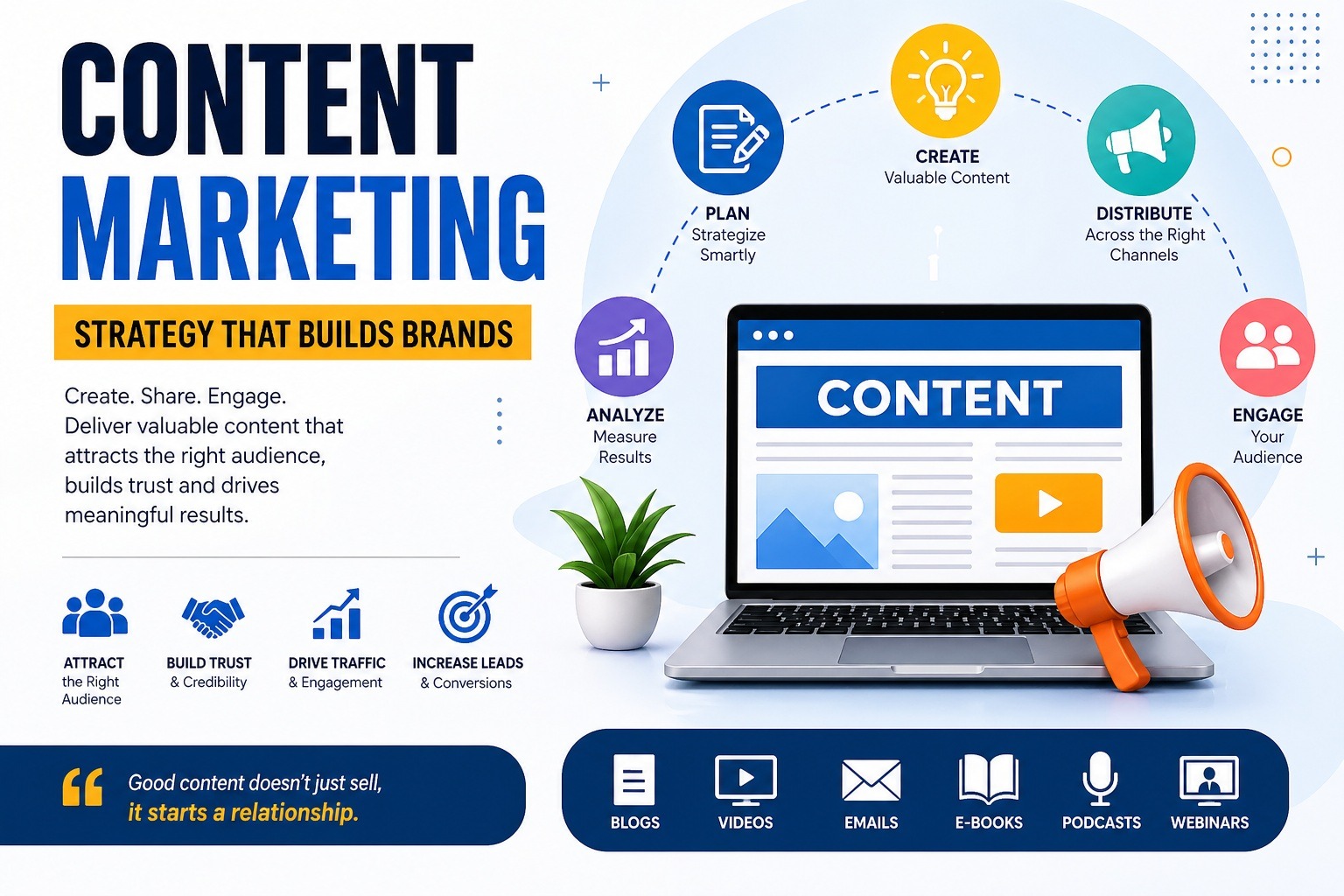
Material marketing is a type of online marketing that involves generating, publishing, and distributing content to a specific audience.
Simply described, it is a marketing approach that involves developing and sharing relevant articles, videos, podcasts, and other media in order to attract, engage, and maintain an audience.
This strategy creates expertise, raises brand awareness, and keeps your company in the forefront of people’s minds when they need to buy what you sell.
Educational articles, newsletters, emails, e-books, videos, entertainment, blogs, and webinars are examples of content marketing. They answer specific questions and give people something they can’t get anywhere else.
It’s the most effective technique to make your product, no matter how ordinary, stand out among other companies in the same industry.
Additionally: Consistency plays a crucial role in content marketing success. Brands that post regularly and maintain a uniform tone and style are more likely to stay in the audience’s mind and build long-term trust.
HOW DOES IT WORK?
Customers do not always walk in a straight line. Because they hold the authority in this place, they get to write their own stories. You can’t expect customers to follow your funnel; all you can do is give out as much useful, free information as possible. The customer has the upper hand. You have no way of knowing what they’ll do once they’ve received your Free Helpful Stuff.
They can fall in love with your products right away and make a purchase. They might completely forget about you. They might hold off for a few years before making a purchase.
Companies who are serious about content marketing construct libraries of eBooks, blog posts, cheat sheets, case studies, and other resources. Rather than relying on a single piece of content to convert a stranger into a customer, they provide a variety of options.
Additionally: Content distribution is as important as content creation. Even high-quality content will not perform if it is not promoted through the right channels such as social media, email marketing, and SEO.
Different companies employ various sorts of Free Content of various lengths (long format and short format) and by various methods (print, design, films, written, audio, etc.).
The are three different kinds of content are: Creation, Curation, and Creative Curation.
Your original content is what you create. This is what you think, what you know, and what you try to explain to others. It could be entertaining or instructive. It takes time and effort; it’s an opportunity to let people know what you have to give and to truly put your work out there and educate others.
Curation is the act of sharing and repurposing other people’s content. So, you’re on Facebook, Twitter, LinkedIn, or any other form of social media. You share someone else’s material after they share yours. This is something that we do with news items and BuzzFeed. It’s simple since it takes less time than making anything from scratch i.e. Creation.
When you curate stuff and then add a comment on it, this is known as creative curation. When you’re on a social networking platform like Facebook or Twitter, or any of them, and you’re sharing someone else’s stuff but making a comment of your own. It’s a benefit for the individual who created the content. You’re assisting them in reaching a larger audience.
Additionally: User-generated content (UGC) can significantly boost credibility. Reviews, testimonials, and customer stories act as social proof and influence buying decisions more effectively than brand-created content.
🔹 Case Study
A small fitness coach started posting educational Instagram reels explaining simple home workouts and diet tips. Instead of directly selling programs, he focused on solving common problems. Within 3 months, his follower base grew organically, and people started approaching him for paid plans. His content built trust first, which later converted into revenue.
PROS AND CONS OF CONTENT MARKETING
ADVANTAGES:
Build brand awareness, trust and loyalty – People who consume your material will form an impression of your company. Your company will be perceived as authoritative and trustworthy if you publish informative, well-researched content. The more your audience’s reliance on you for knowledge, the better.
Reach an audience who may avoid ads – You can attract potential consumers who use ad blocking software or purposefully avoid or ignore traditional advertising by using content instead of traditional advertising.
Keep costs down – There are no media placement fees, and the majority of the work may be completed in-house. As a result, your expenses will be kept to a minimum.
Increase traffic and conversions – Quality content attracts visitors to your website, increasing traffic. You can encourage them to register or make a purchase once they’ve arrived at your site.
Support your other marketing tactics – Many other marketing methods, such as search engine optimization, social media, and public relations, rely on good content to succeed.
DISADVANTAGES
The benefits aren’t immediate – Content marketing is a time-consuming activity. Before you see results, you usually have to go through a period of trial and error to figure out what works best.
Skills and resource – Content marketing might take a long time. You must generate content, distribute it throughout your marketing channels, and assess its effectiveness.
Finding content ideas – It can be difficult to come up with new topics and formats that are both successful and interesting. As you progress, you will be able to assess the impact of prior content.
Evaluation – The impact of your content marketing on site traffic and online conversions is pretty easy to track. Determining the impact of your content on brand reputation, awareness, and loyalty can be difficult.
KEY CHARACTERSTICKS
Target Audience- Your present consumers are the primary focus of content marketing. Share information that your customers are interested in to build a relationship with them. Content marketing can also attract potential clients since they are interested in what you have to say.
Tell a Story- Instead of marketing your brand, tell a story to raise brand recognition. If you write with your personality, it helps to convey a tale; attempt to give your business a personable and trustworthy ‘voice.’
Provide Value- Every piece of ‘content’ you produce should aim to enlighten, educate, and/or entertain your intended audience. Remember that content isn’t considered “content marketing” until it’s entertaining, relevant, and beneficial to your target audience.
Create a Conversation- Create a dialogue with your customers instead of directing them and “selling” your business. Invite your audience to take engage in your content marketing by responding to their queries and comments. This not only humanizes your brand, but it also demonstrates your sincerity to your consumers.
Increase Profits- Content marketing enhances site traffic while also establishing a relationship with your target audience. Customers will feel more informed and more likely to trust your business when making a purchase decision if you provide honest content.
🔹 Case Study
An e-commerce skincare brand began publishing blog articles answering common skincare concerns like acne, oily skin, and pigmentation. They optimized content for SEO and shared it across social media. Over time, their website traffic increased significantly, and customers started purchasing products after reading informative content rather than ads.
The 7C’s of marketing are clients, convenience, competitiveness, communication, consistency, innovative material, and credibility. These seven variables will work as a road map for your marketing strategy and serve as reminders of the most important aspects of a successful campaign.
Many other features and concepts of content marketing are yet to be covered. Join DelhiCourses to receive in-depth understanding about Digital Marketing principles and the opportunity to learn from industry experts.
Delhi Courses Academy is a leading institute offering the best digital marketing course in Delhi NCR known for its practical training, affordable fees, and industry-focused curriculum. With 15+ certifications, 100% placement assistance, and hands-on projects, it prepares students for real-world challenges.